Audit Mode: Defensible AI for Real Investment Decisions

Don Muir
CEO & Co-Founder
We built F2 to help deal teams make better decisions, faster – without compromising rigor.
Over the past few years, AI has made it dramatically easier to generate answers. But in private markets, trust is binary. Answers alone are not enough. If you can’t trace a number, explain how it was calculated, or defend it in front of an investment committee, it doesn’t matter how quickly it was produced.
That’s the gap Audit Mode closes.
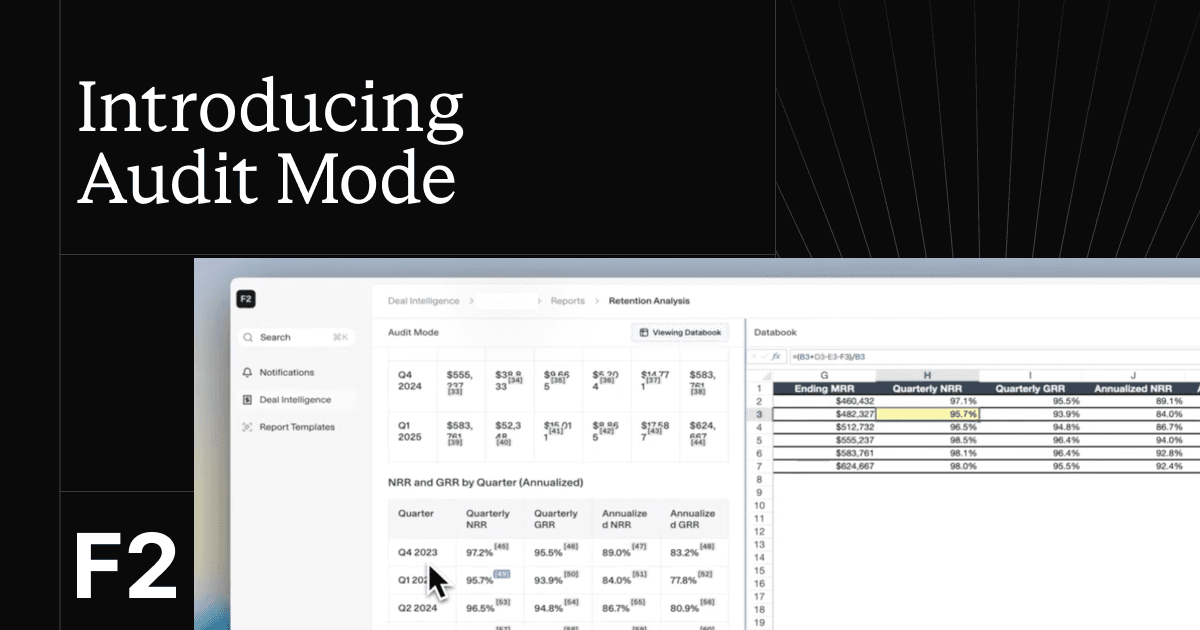
Audit Mode makes every AI-generated calculation auditable and traceable in an Excel-native Databook, the format investors already know and trust. Teams move faster because they don’t need to manually rebuild or verify the work. Auditability is built in from the start.
Speed Without Defensibility Doesn’t Scale
Most AI tools in finance optimize for surface-level speed. They generate outputs quickly, but the underlying work is opaque and based on erroneous assumptions or missing data. That creates friction downstream: analysts recheck results, teams rebuild models, and investment committees ask questions that send work back to the start.
If teams still have to manually rebuild or recheck the analysis before IC, the time savings don’t just evaporate, but this ends up creating more work.
Real speed in private markets comes from trust. And trust comes from auditability.
Audit Mode embeds traceability directly into deal workflow.
Introducing the Databook
At the core of Audit Mode is Databook, an Excel-native system that preserves the work behind every number, and is built directly from source documents in the data room.
F2 assembles data across CIMs, financial statements, and other deal documents. It reconciles differences between sources, applies firm templates and preferences, and writes every calculation into a live, formula-rich, and source-linked Excel workbook that reflects how the analysis was constructed.
The Databook becomes the foundation for all deal-level reports and insights. A single source of truth that can be audited, updated, and extended.
Audit Mode: See the Work, Not Just the Result
Audit Mode is the inspection layer that brings Databook to life.
From any report, analysis, or chat output, users can click into a number to view the Databook and see exactly how it was produced. The underlying formulas and source documents are available inline and in context.
Auditability is built directly into the workflow, not added as a separate step.
And because Databook is Excel-native, teams can keep working the way they always have. They can export the Databook, extend the analysis, and collaborate in Excel without losing visibility into how the numbers were generated.
With Audit Mode teams can:
- Trace any value back to its exact source file, sheet, and cell
- Audit live Excel formulas, including precedents and dependents
- Verify assumptions instantly with linked citations and source previews
- Export clean, auditable Excel outputs without losing traceability
- Create banker grade spreadsheets automatically formatted to match your firm’s style
Built for IC Review
Audit Mode is designed for key moments in the deal process: internal reviews, partner discussions, and investment committee meetings.
When every number can be traced, audited, and verified, review cycles compress.
The difference is practical: fewer back-and-forth cycles, fewer late-night rebuilds, more confidence in the work presented, and faster decisions.
The Future of AI in Private Markets
AI will not replace judgment in investing, but it will increasingly shape how that judgment is formed.
Winning in private markets means working faster and more accurately, and the systems that enable that must have auditability at their core.
Audit Mode is a big step toward that future. It’s how we make AI usable in real financial workflows, where defensibility is non-negotiable and confidence is earned.
When transparency is built into the foundation, speed follows.
If you’d like to see Audit Mode in action, book a demo and see how F2 helps teams move from data room to decision with confidence.
Continue reading